How I Grew a Skool Community to $1K/Month (Free to Paid, Full Breakdown)
How I Grew a Skool Community to $1K/Month (Free to Paid, Full Breakdown)
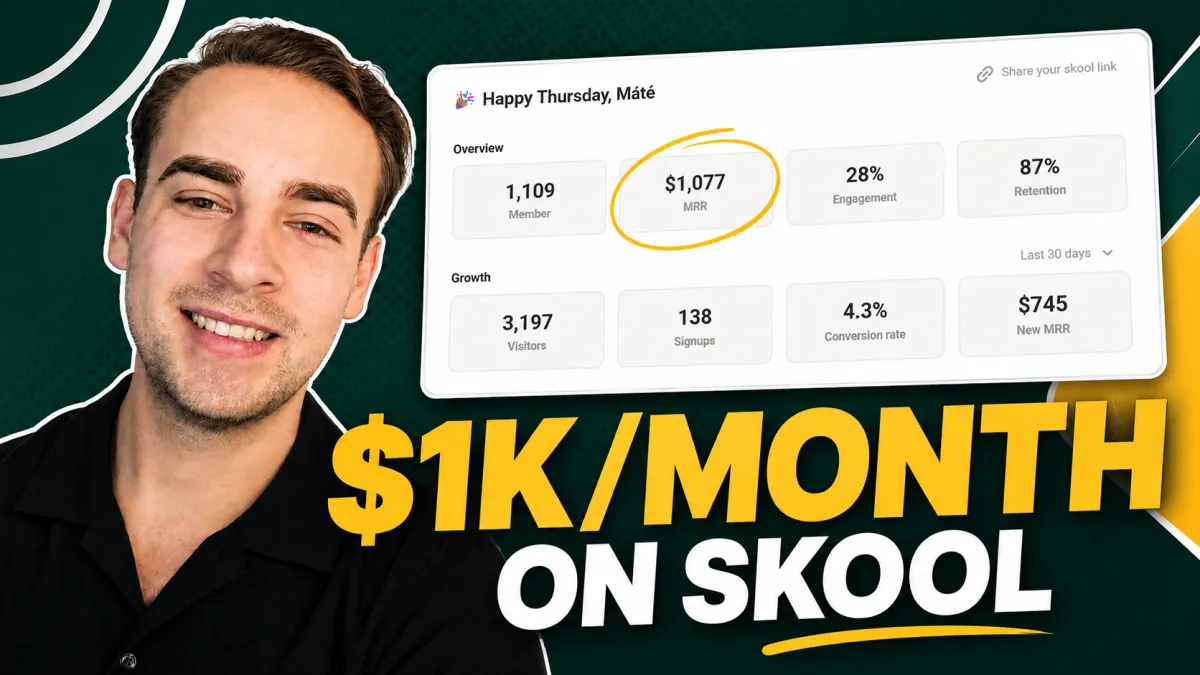
I just passed $1,000 a month in recurring revenue on my Skool community, and I did it without a big audience. No big social following, just media buying experience, some ad budget, and a lot of showing up.
In this breakdown I am going to walk you through the whole thing in two parts: how I grew the community when it was free, and then how I monetized it. If you would rather watch the full version, the video is here: How I Grew My Skool Community to $1K/Month (Free to Paid)
Treat your Skool like a business (with one advantage)
A Skool community is really similar to running a business. You need to know what you talk about, and you need proof. If you sell a bodybuilding program, you need to look like someone who lifts. If you teach people how to make a million dollars a month, it helps if you are making that kind of money. In my case, I worked as a paid media buyer at multiple marketing agencies, so I talk about Meta ads.
The most important rule: do not lie to your audience. It is completely fine to say "I do not know everything about paid ads, but I spent $2,000 last month and here is what I learned." That is exactly what I am doing with this. I am not telling you how to scale a community to $10K or $20K a month, because I have not done it. I am telling you how I got to $1K, what worked, and what I am doing next.
Here is the one big difference between a business and a Skool community: Skool acts like an investor or an advisor. When you drive traffic to your about page, Skool rewards you with more traffic from its network. When you understand SEO, Skool rewards you with higher search rankings, and ranking on Skool is much easier than ranking on Google. This is the same systems-thinking we apply inside Meta Ads Systems.
Part 1: Growing the free community
I started with media buying experience, some ad budget, and zero audience. So I did the thing most people would not: I ran ads to a free, empty community. I figured a community about ads should not look empty, and it worked.
The best practices that moved the needle
Before the ads, the foundation. These helped me the most, and they will help any Skool owner:
Clean up your redirect link. If you share your community in your link in bio, video descriptions, or ads, do not use a redirect or a link shortener. It confuses Skool and messes up attribution. Just use your about page URL. Skool also prefers traffic coming from YouTube and social platforms over direct traffic.
Engage on Skool, especially in the Schoolers community (the group of Skool owners). Skool is a social platform, so post, comment, and start conversations. Do not pitch everyone who engages, that turns people off. Being active matters even more once your community is paid. You can actually check an owner's activity before joining, and nobody wants to pay $9 a month for a dead community where the owner never shows up.
Keywords and SEO. Stack the keyword you want to rank for. I want to rank for "meta ads," so I put it in my community name, description, and cover image, and I used all 11 keyword slots (meta ads, meta, advertising, and so on). I have ranked number one and number three for "meta ads" in Skool search. Rankings shift, so update it over time. If your ad fundamentals are shaky, our Meta ads training covers them.
Optimize your about page. Add a VSL and testimonials, ideally both. People check your vibe before they pay. I use Loom for my about page videos because the thumbnail animates instead of sitting static, which is more engaging (the trade-off is a couple of seconds of load time). I also feature member wins and feedback.
The cover image. Treat it like a YouTube thumbnail. My progression went from a plain no-face image (fine for a free community) to my face with big text saying "master meta ads." This matters because Skool runs ads to your community using your cover image, so a better cover means better-performing Skool ads, which means Skool sends you more traffic. People do judge a book by its cover.
My ad strategy for the free community
The structure was simple: one CBO campaign. I started with a headline test, same ad concept, different headlines. The winner leaned on social proof: "learn Facebook ads from someone who spent $5 million on them." That beat the other angles clearly.
Next round, I expanded from US-only to several tier 1 countries, and my cost per registration dropped to about half. The same winning ad with short copy pulled basically all the results at around $5 per signup. I grew my first 200 or so members with Facebook ads, then organic reach and Skool search took over and the snowball effect kicked in.
Part 2: Turning it paid
Here is the story that changed everything: my failed launch.
I had a thousand members, so I figured if I could sell even 1%, I would make good money. I rolled out a program about growing a Skool community with ads. Almost nobody bought. One or two people. The problem was that most of those thousand members had joined a free community from ads two years earlier, back before Skool was popular, and they were inactive. Out of a thousand members, maybe 300 still used Skool, and they had joined something free. They were never going to pay.
That frustrated me, all that time and money to grow to a thousand members, and nobody cared. So I decided to turn the community paid. If people want my free content, it is on YouTube. Inside, I would build a real classroom.
My pricing and tiers
I set up a tier structure I still use today:
Standard, $9 a month with a 7-day free trial, so there is basically no risk. Full classroom access. To improve lifetime value, the classroom unlocks over time: phase one during the trial, phase two after the trial, and the AI workflows and advanced scaling systems unlock at 40 and 70 days, or instantly if you upgrade.
Premium, $79 a month, everything in Standard plus weekly live calls (I run them morning and evening so US and Australia time zones both work) and live campaign reviews.
VIP, $798 for a full year, everything in Premium plus an onboarding and audit call and six weeks of one-on-one ad mentorship with me.
The change that actually worked: free trials
I was skeptical about free trials because of my failed launch, I assumed free meant unserious. I was wrong.
The day I added a 7-day free trial, everything changed. My conversion rate had been hovering around 2%. It shot up to 6%. Seven days later my MRR started climbing as trials converted to paid, and it kept going. Even accounting for a 50% trial-to-paid rate, my effective conversion beats where I was before. I also believe Skool pushes more traffic to communities that offer a free trial. If there is one thing to copy from this article, it is this one. The tracking discipline behind measuring it is the same we teach with our AI creative workflows.
Growth Boost
Growth Boost is another way Skool acts like an investor. You turn it on, and Skool gets you customers through search, discovery, and the ads it runs to your community, in exchange for a percentage. Think about it: if your group is $99 a month and Skool brings you a signup for the equivalent of $33, that is a great deal, and instead of paying that to Meta, you pay it to Skool. They recently changed it to a slider so you can choose how much to give.
One warning: Growth Boost will not fix a bad community. If your churn is high and nobody converts on your trial, cranking the slider will not save you. Get the basics right first, a good onboarding, a real classroom, a product people actually refer, then scale Growth Boost.
What I am doing next (scaling to $3K)
My next goal is $3K MRR. The plan: keep posting long YouTube videos twice a week, a weekly live call, and short-form daily, plus repurposing everything into social posts and blog articles (some of which rank number one on Google). I am collecting more reviews (without incentives, since Skool penalizes that), getting more member wins, improving the classroom as Meta keeps changing, and perfecting my CRM and DM flow to activate free-trial members.
I am also raising prices on September 1: the $9 Standard plan moves to $27. The goal is to push more people toward the yearly plan, which is where I provide the most value and where members stay longer instead of churning at month four or five.
Want to see inside?
Everything I just walked through, the ad strategy, the classroom, the AI creative workflows, is inside Meta Ads Systems, my Skool community. I build in public, share my exact numbers on my weekly live calls, and you get the exact prompts and workflows I use, backed by real member wins.
Join Meta Ads Systems on Skool, start with the free trial, and come see the process from the inside.
Heads up: the price goes up on September 1 ($9 Standard moves to $27), and existing members are grandfathered, so joining before then locks in the current rate for good.
And if you want the full walkthrough with my real dashboard and numbers on screen, the video is here: How I Grew My Skool Community to $1K/Month (Free to Paid)