How I Made $60K on Upwork: Profile Optimization and Freelancing Tips
How I Made Over $60K on Upwork: What Actually Worked
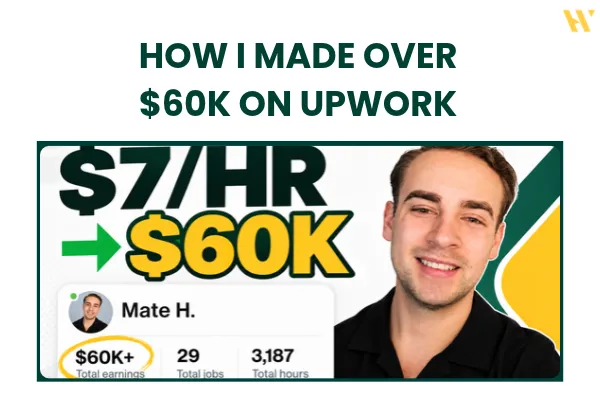
I made over $60,000 on Upwork.
But I definitely did not start there.
When I first started freelancing, I was making around $7 per hour doing social media management. I was creating posts, scheduling content, helping with basic branding, and taking whatever experience I could get.
Eventually, I became Top Rated Plus, maintained a 100% Job Success Score, completed more than 35 projects, worked thousands of hours, and earned over $60,000 through the platform.
In my new video, I break down the entire journey and then show you exactly how I optimize my Upwork profile and choose freelance jobs today.
Watch the full video here:
But there is a bigger lesson behind the $60K number.
Upwork helped me find clients. It was not the actual reason I was able to increase my income.
The real change happened when I developed a skill businesses were willing to pay more for.
I Started Trying to Make Money Online in 2016
Back in 2016, making money online still felt strange to me.
I grew up with the normal path in mind. Go to university, get a normal job, and make your money that way.
Then I started learning about digital marketing and online business.
One of the first things I tried was growing Instagram theme pages.
This was around 2017 and 2018, when theme pages were everywhere. I had meme pages, travel pages, dog pages, nail pages, and other accounts.
At first, I grew them from zero.
Later, I started buying existing pages, growing them, monetizing them with shoutouts, and eventually selling them.
At one point, I had roughly 800,000 followers across the pages.
I would sometimes buy a page for a few hundred dollars, grow it, make some money selling shoutouts, and then sell the account for much more.
That was probably the first time I really understood that people would pay real money online.
My First Online Business
One of my nail pages eventually became my first real ecommerce experiment.
My girlfriend created press-on nail designs, and we started selling them to followers of the page.
It was simple, but it taught me something important.
I had now made money online from:
selling services
selling audiences
selling shoutouts
selling digital assets
selling physical products
At that point, freelancing did not seem like some unrealistic internet opportunity anymore.
It seemed like a legitimate way to eventually leave my full-time job.
Starting on Upwork at $7 Per Hour
I eventually created an Upwork profile and started freelancing as a social media manager.
My rate was around $7/hour.
Nothing impressive.
But that first stage was not about maximizing my hourly rate. I needed projects, reviews, experience, and proof that I could actually deliver work for clients.
For about three or four months, I freelanced while keeping my full-time job.
Eventually, my freelance income started matching what I was making at the job.
So I quit.
I went all in on freelancing and social media management.
That was a huge step, but another problem became obvious pretty quickly.
Why I Moved From Social Media Management to Paid Ads
Social media management was fine.
I could make posts, schedule content, create graphics, and manage accounts.
But I realized businesses were much more willing to pay for something directly connected to revenue.
That pushed me toward paid advertising.
If you can help a company generate serious revenue, your value is much easier to demonstrate than if you're simply posting three times per week.
So before calling myself an advertising expert, I started spending my own money.
I ran ads for my own businesses.
I promoted my services.
I tested campaigns.
I made mistakes with my own money.
Only after getting some practical experience did I start applying for paid advertising and Meta Ads projects for other businesses.
That shift completely changed my freelancing career.
If you're interested in the Meta Ads side of this journey, I have a dedicated training page here:
https://www.wupscale.com/meta-ads-training
You can also see the Meta Ads system and community here:
https://www.wupscale.com/meta-ads-systems
From $7/Hour to Top Rated Plus
Over the next couple of years, the projects got better.
I built experience across paid advertising, social media, design, and different types of digital marketing work.
Eventually, my Upwork profile reached:
$60,000+ earned
Top Rated Plus
100% Job Success Score
35+ projects completed
3,000+ hours worked
One of the client results I'm especially proud of involved approximately $400,000 in ad spend generating around $1.3 million in revenue.
That type of result became far more valuable on my profile than simply saying I knew how to use Facebook Ads Manager.
This is why I think freelancers obsess too much over Upwork tactics before they have enough proof.
Yes, your profile matters.
Yes, your proposals matter.
But the strongest thing you can eventually put on your profile is a real result.
You can see more of my Meta Ads work and case studies here:
https://www.wupscale.com/results
How I Optimize My Upwork Profile
Once you have a skill to sell, your Upwork profile needs to make that skill obvious.
Don't make clients figure out what you do.
Start With Your Headline
Your headline should contain the keyword clients are actually searching for.
In my case, that means Meta Ads Specialist.
I also add social proof around my experience managing ad spend.
There are two reasons for doing this.
First, a potential client immediately understands what I do.
Second, Upwork is also a search engine.
If someone searches for a Meta Ads specialist, having that exact service clearly represented throughout your profile helps Upwork understand when your profile is relevant.
Don't try to sound clever.
Be clear.
Fill Out Your Description
My description explains:
what I specialize in
the types of projects I've worked on
the amount of advertising spend I've managed
the services I can help with
the type of client I'm looking to work with
Again, clarity beats trying to write some massive sales letter.
Tell them what you do and prove that you've done it.
Complete the Entire Profile
This sounds basic, but there is no reason to leave free profile sections empty.
I added:
portfolio examples
relevant skills
testimonials
certifications
education
languages
weekly availability
ID verification
an introduction video
Upwork lets you add a large number of skills, so use them.
If you have previous clients outside Upwork, you can also request testimonials from them.
Your first goal should be to build as much legitimate social proof around your profile as possible.
Should You Start With a Low Rate?
This is probably one of the more controversial things I mention in the video.
When you're brand new, I don't think you should obsess over charging the highest possible hourly rate.
If nobody knows you and you have zero reviews, getting the first successful project is extremely important.
I started at $7/hour.
Someone starting from zero may need to take a very inexpensive first project to get that initial five-star review and work history.
That does not mean staying cheap forever.
The point is to get momentum.
Once you've completed projects, built reviews, developed better skills, and generated actual results, raise your rates.
Being cheap forever is not a strategy.
Using an easier first project to establish your profile can be.
I Also Use Upwork's Paid Features
Today, I use the availability badge and profile boosting.
I also tested Freelancer Plus.
I already know I'm willing to spend money acquiring clients through Meta Ads, so I don't see paying a few dollars to get visibility in front of a highly relevant Upwork client as fundamentally different.
But this only works when your profile is already solid.
Do not boost a weak profile and expect money to fix the problem.
First build the profile.
Then improve distribution.
How I Choose Upwork Jobs
One of the biggest mistakes is applying for everything.
I don't.
When I look at a job, I check the client first.
For example:
How much have they already spent on Upwork?
What are their reviews like?
Is their payment method verified?
What is their hiring rate?
What hourly rates have they paid previous freelancers?
Are they actively interviewing people?
Does the project actually match what I do?
In the video, I walk through an example of a company looking for a Google and Meta Ads specialist.
They had spent hundreds of thousands of dollars on Upwork, had strong reviews, a verified payment method, and a serious hiring history.
That is a very different opportunity from a brand-new account posting a vague job with no payment verification and a tiny budget.
You have a limited number of Connects.
Use them on jobs you could realistically win and actually want.
Stop Sending Generic AI Proposals
This is probably my favorite Upwork tip from the video.
Don't automate everything.
Clients are already getting flooded with generic AI proposals.
You can usually tell exactly what happened.
Someone pasted the job description into ChatGPT, generated a long response, and submitted it without adding anything personal.
Instead, I like using Loom videos.
Sometimes my written response is extremely short.
I tell them I recorded a quick video and send the Loom.
Then, in two or three minutes, I can:
introduce myself
explain how I'd approach the project
show relevant past results
pull up previous campaigns
explain what I noticed in their job post
let them see how I communicate
Before they've even interviewed me, they already know what I sound like and how I think.
That is much harder to replicate with a generic AI-generated application.
AI is useful.
I use AI constantly.
But using AI to remove every piece of your personality from a freelance application is stupid.
The client is hiring a person.
Act like one.
The Biggest Lesson From Making $60K on Upwork
Upwork gave me access to clients.
But the platform was not the real asset.
The skill was.
Social media management got me started.
Paid advertising allowed me to become much more valuable.
The better I became at Meta Ads, campaign analysis, creative strategy, optimization, and client communication, the easier it became to justify higher-value work.
That's what I would focus on if I was starting over.
Get good at something useful.
Build proof.
Create a complete profile.
Take the first jobs seriously.
Collect reviews.
Apply selectively.
Show some personality.
Then keep moving toward more valuable work.
Watch the full video here:
You can find more practical Meta Ads tutorials here as well:
Want to Learn the Skill I Used to Grow My Freelance Career?
Upwork was where I found clients.
Meta Ads became one of the main skills I could sell to those clients.
If you want to learn how I approach campaign setup, creative testing, optimization, scaling, AI creative workflows, and actual Meta Ads decision-making, join Meta Ads Systems.
👉 https://www.skool.com/advertising
You can also learn more about the system here: