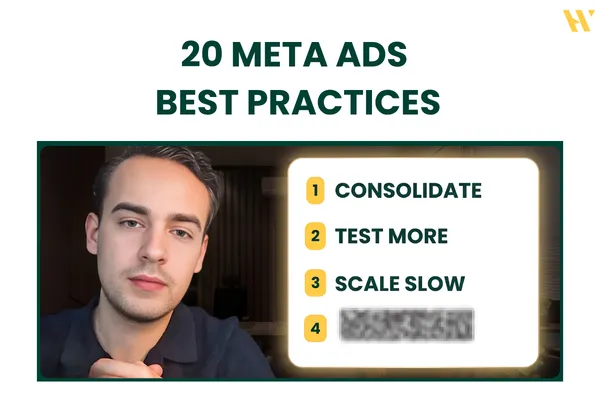
20 Meta Ads Best Practices That Are Working Right Now After $5M+ in Ad Spend
Meta Ads are changing fast.
What worked two years ago does not always work today. What worked six months ago might already be weaker now. Campaign structures are changing. Targeting is changing. Creative testing is changing. Meta is pushing advertisers more and more toward automation, Advantage+ audiences, broad targeting, and creative-driven delivery.
That is why I wanted to break down the Meta Ads best practices that are working right now, based on what I have seen after managing over $5M in ad spend across ecommerce stores, lead generation campaigns, local businesses, coaches, service businesses, and online offers.
You can watch the full video here:
https://www.youtube.com/watch?v=mYGpSmYGFJY
This is not theory. These are the practical rules I would follow if I were setting up, testing, optimizing, or scaling Meta Ads today.
1. Consolidate Your Campaigns
One of the biggest mistakes I still see in ad accounts is overcomplication.
Too many campaigns. Too many tests. Too many random ad sets. Too many ideas running at the same time.
If you only have a small budget, spreading that budget across 10 or 15 campaigns makes no sense. Meta needs enough data to optimize. You need enough spend in one place to actually understand what is working.
A cleaner structure usually performs better because it gives the system more data and gives you cleaner reporting.
A simple setup could look like this:
One main testing campaign
One scaling campaign
One audience testing campaign if needed
Most accounts do not need 15 campaigns. They need fewer campaigns, better creative tests, and clearer decisions.
2. Use CBO When You Have a Smaller Budget
CBO stands for campaign budget optimization. This means you set your budget at the campaign level, and Meta decides how to distribute that budget between the ad sets.
ABO stands for ad set budget optimization. This means you set the budget manually at the ad set level.
If you have three ad sets and you set $10 per day on each, each ad set gets $10 per day. The problem is that one ad set might be much stronger than the others, but it is still limited to the same budget.
With CBO, Meta can push more budget toward the ad set that has more potential.
For smaller budgets, CBO is usually the better starting point. You are letting the system allocate spend based on performance instead of forcing every ad set to spend equally.
3. Use Broad Targeting
Targeting is not what it used to be.
A lot of advertisers still think the winning strategy is stacking interests, adding lookalikes, building custom audiences, and trying to manually force Meta to find the right person.
That is becoming less important.
The targeting now happens more through the creative. Your hook, headline, ad copy, offer, image, video, and landing page tell Meta who should see your ad.
If your ad says, “For coaches stuck at $5K per month,” that creative is already filtering people. If your video talks directly to ecommerce brand owners, Meta can use that signal.
Broad targeting gives the algorithm room to find people. Your creative gives it direction.
4. Keep 5 to 10 Ads Per Ad Set
Another common mistake is either testing too many ads in one ad set or creating one ad set for every single ad.
Both are messy.
If you put 19 ads into one ad set, especially with a low budget, most of them will not get enough spend. You will not know which ads actually had a fair test.
But if you create one ad set per ad, you end up with 20 or 30 ad sets, which becomes a nightmare to manage.
A good rule is to test around 5 to 10 ads per ad set.
That gives Meta enough options, but it still keeps the test clean enough for you to read the data.
5. Test Copy Before Creative
Before testing a bunch of different images, videos, or formats, I like to test copy first.
Why?
Because copy helps you understand the message your audience responds to.
You can keep the creative the same and test five different versions of the primary text. Once you find a winning angle or message, you can use that copy as the base for your next creative tests.
The creative is usually more important than the copy, but copy testing gives you direction.
Find the message first. Then test different creative concepts around that message.
6. Test One Variable at a Time
If every single thing changes between your ads, you cannot know why one ad won.
If one ad has a different image, different copy, different headline, different CTA, and different landing page, what actually caused the performance difference?
You do not know.
That is why structured testing matters.
If you are testing copy, keep the image, CTA, landing page, headline, and offer the same. Only change the copy.
If you are testing creative, keep the copy and landing page the same. Only change the creative.
This gives you cleaner data and better decisions.
7. Focus on the Hook in Video Ads
If you are running video ads, the first three seconds matter a lot.
The hook is what stops the scroll. If the hook is weak, people do not watch the rest of the video. It does not matter how good the middle or ending is if nobody gets there.
Your hook can be a strong statement, a visual pattern interrupt, a pain point, a result, a bold claim, or a direct callout.
The first three seconds should make the right person feel like, “This is for me.”
That is where most video ads win or lose.
8. Track Hook Rate and CTR Benchmarks
You need benchmarks. Without benchmarks, you are just guessing.
For video ads, one useful custom metric is hook rate. You can calculate this by dividing 3-second video plays by impressions.
A good hook rate benchmark is around 25% or higher.
For image ads and landing page campaigns, link click-through rate matters. In the past, 1% link CTR was a decent benchmark. With higher CPMs and changes in targeting, aiming closer to 2% is a stronger benchmark now.
These numbers can vary by industry, but you need some kind of standard.
If your hook rate is weak, fix the hook.
If your CTR is weak, fix the creative, headline, or offer.
If people click but do not convert, look at the landing page or funnel.
9. Pause Ads After 1x CPA With No Conversion
You do not need to let bad ads waste money forever.
If your average cost per acquisition is $15 and an ad spends $15 to $20 with zero conversions, it is usually not a winner.
A winning ad often starts strong and then gets more expensive over time. Bad ads usually show bad signs early.
You can also make earlier decisions if the CTR is terrible.
For example, if your CTR benchmark is 2%, but an ad spends $5 to $10 and has a 0.5% CTR, that ad probably does not deserve more budget.
Do not get emotional with tests. Read the data and cut what is clearly not working.
10. Always Test New Ads
Meta needs fresh creative.
If you keep running the same ads forever, performance usually drops. People get tired of seeing them. The algorithm has fewer new signals to work with.
You should test new ads every week if you are serious about improving performance.
Test different:
Video styles
Images
Carousels
UGC-style content
Animations
Hooks
Angles
Offers
Headlines
Meta Ads are creative-driven. If you are not feeding the system new creative, you are limiting your own results.
11. Iterate on Winners Before Testing Brand New Concepts
Testing new ads is important, but do not ignore what already works.
If you have a winning ad, your first move should often be iteration, not replacement.
For example, if you have a video with a 35% hook rate, do not change the hook immediately. The hook is working. Instead, test a different CTA, a different ending, or a different offer angle.
If you have a winning image, try changing the background color, headline, layout, or format.
Big new concepts are useful, but small changes to proven winners can often create better results faster.
12. Use Facebook and Instagram Placements Only
Advantage+ placements can work, but I have recently seen issues with Audience Network.
Sometimes Audience Network can create suspiciously high click-through rates because people accidentally click ads inside apps or games.
That looks good in the dashboard, but it does not mean those clicks are valuable.
If you see a CTR that looks way too high, check placements. If most of the spend is going to Audience Network and conversions are weak, that is a red flag.
In many cases, it is safer to focus on Facebook and Instagram placements only.
13. Use Advantage+ Audience
While I am careful with placements, I do like Advantage+ audiences.
Meta is getting better at finding the right people when your creative and offer are clear.
Even if you are targeting a specific audience, like women coaches or German-speaking buyers, you can often still use broad Advantage+ audience and let the creative do the filtering.
The key is that your ad must clearly speak to the right person.
Broad does not mean random. Broad gives Meta room. Creative gives Meta direction.
14. Turn Off AI Creative Enhancements
Meta keeps adding AI creative enhancement options.
Music. Text improvements. Overlays. CTA changes. Image adjustments.
Right now, I usually turn these off.
The issue is control. You created the ad a certain way for a reason. You chose the image, text, hook, layout, and call to action. If Meta changes those elements automatically, the ad can become off-brand or unclear.
These features may improve in the future, but right now, I prefer to keep control over the creative.
15. Scale Slowly With 20% Budget Increases
When you find a winning campaign, the temptation is to double or triple the budget.
That can kill performance.
Large budget jumps can disrupt delivery and reset the stability of the campaign. A safer approach is to increase budget by around 20% at a time, then wait two to three days before increasing again.
For example:
$50 to $60
$60 to $72
$72 to $86
This is slower, but it is safer. Scaling is not just about spending more. It is about spending more without destroying the results.
16. Duplicate Winning Ads Into a Scaling Campaign With Post IDs
Another way to scale is to duplicate winning ads into a scaling campaign using post IDs.
This lets you keep the same social proof, including likes, comments, and shares.
Instead of editing or rebuilding the ad from scratch, you can use the post ID and move the winner into a new scaling campaign.
This is powerful because the ad already has proof, and you can start the scaling campaign with a higher budget without directly disrupting the original testing campaign.
Post IDs are one of the most underrated Meta Ads tactics.
17. Never Edit Existing Ads
If an ad is already running and has spent money, do not edit it.
Editing makes the data messy.
If an ad spent $30 and generated 50 clicks, then you change the copy or landing page, how do you know whether the future results are because of the original version or the edited version?
You do not.
Instead, duplicate the ad, make the change in the new version, and start fresh.
Clean data matters. Do not ruin it by constantly editing live ads.
18. Use Dayparting With Lower Budgets
Dayparting means running ads only during certain days or hours.
This can be useful if you have a lower budget and you know your conversions usually happen during specific time windows.
For example, if most conversions come on Tuesdays and Wednesdays between 1 PM and 6 PM, you can use dayparting to spend more during those windows and avoid wasting budget during weaker times.
This is more advanced and works better when you already have data.
Do not guess. Use your account data first.
19. Use Cost Caps When Performance Drops
Cost caps can be powerful when performance starts to drop.
A cost cap tells Meta the approximate cost per result you want.
For example, if your average CPA is $15, you might set a cost cap around $15 to $16.
This strategy works best when you already have data. If you have no conversion history, Meta has less information to work with.
Cost caps are not something I would always use from day one, but they can help when an account has scaled and CPA starts climbing.
Final Thoughts
The biggest lesson from all of this is simple: Meta Ads are moving toward simpler structures, broader targeting, better creative, and cleaner testing.
You do not need a complicated ad account. You need a clear testing system.
You need to know what you are testing. You need to feed Meta fresh creative. You need to track the right benchmarks. You need to pause bad ads quickly and scale winning ads carefully.
Most advertisers overcomplicate the setup and underinvest in creative.
That is backwards.
Your campaign structure matters, but your creative, offer, message, hook, and funnel matter more.
If you want the full breakdown, watch the video here:
https://www.youtube.com/watch?v=mYGpSmYGFJY
If you want help learning how to launch, optimize, and scale Meta Ads with a structured system, join my Skool community here:
https://www.wupscale.com/skool