How Meta Ads Work for Growing a Skool Community
A lot of Skool group owners want more members, but most of them are still relying on the same few growth methods.
They post content.
They comment in communities.
They send DMs.
They hope the algorithm sends them the right people.
Those things can work, but they also have limits. If your growth depends only on your daily energy, your free time, and whether your content performs that day, your community growth will always feel unstable.
This is where Meta ads can become a serious growth lever for Skool communities.
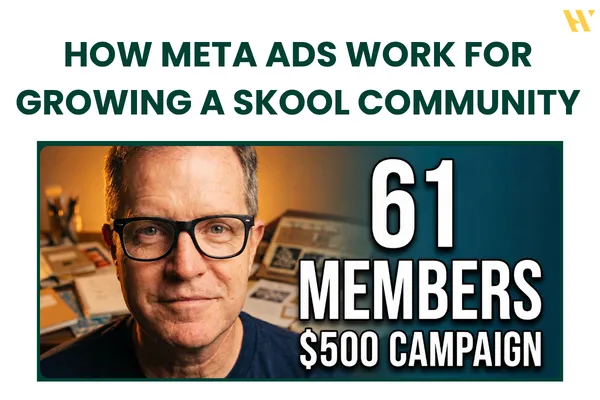
In this video, Kevin Gregg shares how he used a $500 Meta ads campaign and brought 61 new members into his Skool community. These were not people who simply clicked an ad and bounced. They had to click through, land on the page, understand the offer, and complete the signup process.
That matters.
Because when someone goes through multiple steps and still joins, it shows that the campaign is attracting people with real intent.
You can watch the full video here: https://youtu.be/9-sYLbH43DI
Why Meta Ads Are Different for Skool Communities
Growing a Skool community is not the same as selling a simple product.
With ecommerce, someone sees a product, likes it, checks the price, and buys. There is still friction, but the path is familiar.
With a Skool community, especially if people are new to the platform, there is more education involved. People need to understand what Skool is, why the group exists, who it is for, what they get inside, and why they should join now instead of ignoring it.
This is why your Meta ads strategy needs to do more than get cheap clicks.
Cheap clicks alone do not build a community. Cheap leads alone do not create engagement. A low cost per result does not matter if the people joining never introduce themselves, never consume the content, and never come back.
The real goal is not just getting people into your Skool group.
The real goal is attracting the right people, getting them to understand the value, and guiding them into the community in a way that creates momentum.
That is the part many Skool group owners miss.
They think the ad campaign is the whole system.
It is not.
The ad campaign is the front door.
The Kevin Gregg Example: 61 Members From a $500 Campaign
Kevin’s example is useful because it shows what can happen when Meta ads are used correctly for a Skool community.
He ran a campaign with a $500 maximum budget and generated 61 new members. For a Skool group owner, that is a strong result because those members did not appear randomly. They came through paid traffic, went through the process, and joined the community.
This is important because Skool communities usually need consistent member flow.
If you are building a paid community, free community, coaching group, educational community, or niche group, you need people coming in consistently. Without that, the community starts to feel quiet. And when a community feels quiet, engagement drops. When engagement drops, retention suffers.
Meta ads help solve the consistency problem.
Instead of waiting for organic content to take off, you can put your offer in front of a targeted audience every day.
But the quality of that traffic depends on three things:
The offer
The creative
The onboarding experience
Kevin’s result worked because the campaign was not just about sending random people into a group. The ad had a specific angle. The audience had a reason to care. The landing experience gave people enough context to take the next step.
Meta Ads Can Help You Find the Right Skool Members Faster
One of the biggest advantages of Meta ads is speed.
Organic growth is valuable, but it takes time. You have to post consistently, test topics, wait for feedback, and build attention slowly. Meta ads let you test faster because you can put different messages in front of real people and see what they respond to.
For Skool communities, this is powerful.
You can test different angles like:
How to grow your business
How to learn a skill
How to join a specific niche community
How to get support from people like you
How to solve a painful problem faster
The market tells you what works.
If people click, sign up, and engage, the angle has potential. If they ignore the ad, bounce from the page, or join and disappear, something is broken.
That feedback is valuable because it helps you improve your messaging.
Most Skool group owners guess their way through positioning. They assume they know what people want. They write copy based on what sounds good to them. Then they wonder why people do not join or stay active.
Meta ads force clarity.
If your offer is confusing, the numbers will show it.
If your creative is weak, the numbers will show it.
If your landing page is not clear, the numbers will show it.
If your onboarding is lazy, the engagement will show it.
That is uncomfortable, but it is useful.
The Creative Does the Targeting
A major shift in Meta ads is that targeting no longer works the way many people still think it does.
Years ago, advertisers spent most of their time trying to find the perfect interest stack. They would test audiences, narrow targeting, and try to outsmart the algorithm.
Today, the creative does a lot of the targeting.
That means your ad image, video, hook, headline, and copy tell Meta who should care about your offer.
If your creative speaks to Skool group owners, Meta can find more people who behave like Skool group owners. If your creative speaks to coaches, creators, agency owners, local business owners, or ecommerce founders, Meta gets signals based on who stops, clicks, and converts.
This matters for Skool growth because the audience is often not only based on demographics. It is based on a problem.
For example, a Skool group owner might be struggling with:
Getting new members
Turning free members into paid members
Improving engagement
Creating a better onboarding flow
Building authority
Running ads without wasting money
Understanding Meta Ads Manager
Making better creatives
Your creative should speak directly to the problem you solve.
If your ad is too generic, you will attract generic clicks.
If your ad is specific, you give Meta better signals and you give people a clearer reason to care.
The Landing Page Has to Educate People
One important point from Kevin’s testimonial is that many people coming from Meta ads may be brand new to Skool.
That is a huge point.
If someone has never used Skool before, they may not instantly understand what they are joining. They might not know what a classroom is. They might not understand how the community works. They might not know why they should introduce themselves or where to start.
This means your landing page, about page, or signup page needs to do more work.
It should explain:
Who the group is for
What problem the group solves
What members get inside
Why the community exists
What result members can expect
What to do after joining
For a Skool community, clarity beats cleverness.
Do not assume people understand your offer.
Do not assume people know Skool.
Do not assume they will figure it out after joining.
That is lazy marketing, and it costs you members.
Your Meta ads can get people to the door, but your page has to help them step inside.
Onboarding Is Where Most Skool Growth Fails
Kevin also brought up one of the most important lessons for anyone growing a Skool community with Meta ads.
Getting people in is only the first step.
If someone joins your group and nothing happens, they will probably disappear.
This is especially true if they came from cold traffic. They do not know you deeply yet. They may not know other members. They may not understand the culture of the group. They may feel awkward posting for the first time.
That is normal.
Most new members want to stand against the wall at first. They want to look around, understand the environment, and avoid looking stupid.
Your job is to reduce that friction.
A strong Skool onboarding process can include:
A short welcome video
A clear “start here” post
A simple introduction prompt
A direct welcome message
A first action step
Tagged conversations
A quick explanation of how to use the group
A reason to come back within the first 24 hours
This is where many community owners get exposed.
They spend all their energy getting people to join, then they do almost nothing to activate them.
That is a waste.
If you pay to acquire a member and then fail to welcome them properly, the problem is not the ad platform. The problem is your system.
Meta ads can create attention.
Your onboarding turns that attention into engagement.
Why Engagement Matters After the Signup
Skool rewards active communities.
If people join but do not engage, your group becomes a list of names instead of a community.
Engagement matters because it creates:
More trust
More retention
More member wins
More testimonials
More referrals
More reasons for people to stay
If you are running a paid Skool community, engagement is not optional. It directly affects retention.
People do not keep paying just because they joined once. They stay when they feel like they are getting value, making progress, and becoming part of something useful.
That means your Meta ads strategy should connect to your community strategy.
The ad should attract the right person.
The page should set the right expectation.
The onboarding should help them take action.
The community should give them reasons to stay.
That is the full system.
What Skool Group Owners Should Learn From This
Kevin’s result is not just about 61 members from a $500 campaign.
The bigger lesson is that Meta ads can work for growing a Skool community when the system behind the ad is strong.
You need a clear offer.
You need creative that speaks to the right problem.
You need a page that explains the value.
You need onboarding that activates new members.
You need follow-up so people do not ghost the platform.
If you skip those pieces, you may still get clicks. You may even get signups. But the community will not grow in a meaningful way.
That is the difference between running ads and building a growth system.
Most people are looking for a trick. They want the perfect campaign setting, the perfect audience, or the perfect ad hack.
That is the wrong mindset.
The real advantage comes from building a simple, repeatable system that gets better every week.
How Meta Ads Systems Helps With This
Meta Ads Systems by Wupscale is built for people who want to understand how Meta ads actually work, especially business owners, creators, marketers, and Skool group owners who want to stop guessing.
The goal is not to make ads feel more complicated.
The goal is to make them more understandable.
Inside the group, the focus is on launching, testing, reading the numbers, improving creatives, and understanding what to do next. That is what most people are missing.
They launch a campaign, panic after a few days, change random settings, then blame the platform.
That is not strategy.
A better approach is to understand what the numbers are telling you.
Are people stopping on the creative?
Are they clicking?
Are they landing on the page?
Are they signing up?
Are they engaging after joining?
Each step tells you something.
If people do not click, your creative probably needs work.
If people click but do not sign up, your page or offer probably needs work.
If people sign up but never engage, your onboarding probably needs work.
That is how you improve.
Final Thoughts
Meta ads can be one of the best ways to grow a Skool community because they give you consistent traffic, faster feedback, and a way to test your offer in the real world.
But ads alone are not enough.
The mistake is thinking that a campaign can fix a weak offer, unclear page, or dead onboarding process.
It cannot.
Meta ads work best when they are connected to a full community growth system. That means the creative, the page, the signup process, the onboarding, and the community experience all need to work together.
Kevin Gregg’s result shows what is possible when the pieces start to connect. A $500 campaign brought in 61 new Skool members, and the bigger lesson is that growth does not stop at the signup.
You still have to welcome people.
You still have to guide them.
You still have to create engagement.
You still have to build the community after the ad does its job.
Watch the full video here: https://youtu.be/9-sYLbH43DI
Want More Meta Ads Breakdowns Like This?
If you want more practical Meta Ads strategies, campaign breakdowns, creative testing systems, and weekly updates, join my Skool community, Meta Ads Systems.
Inside, I share what is working right now with Meta Ads, including campaign setup, optimization, scaling, AI creative workflows, audience strategy, and real examples from live ad accounts.
Join here: