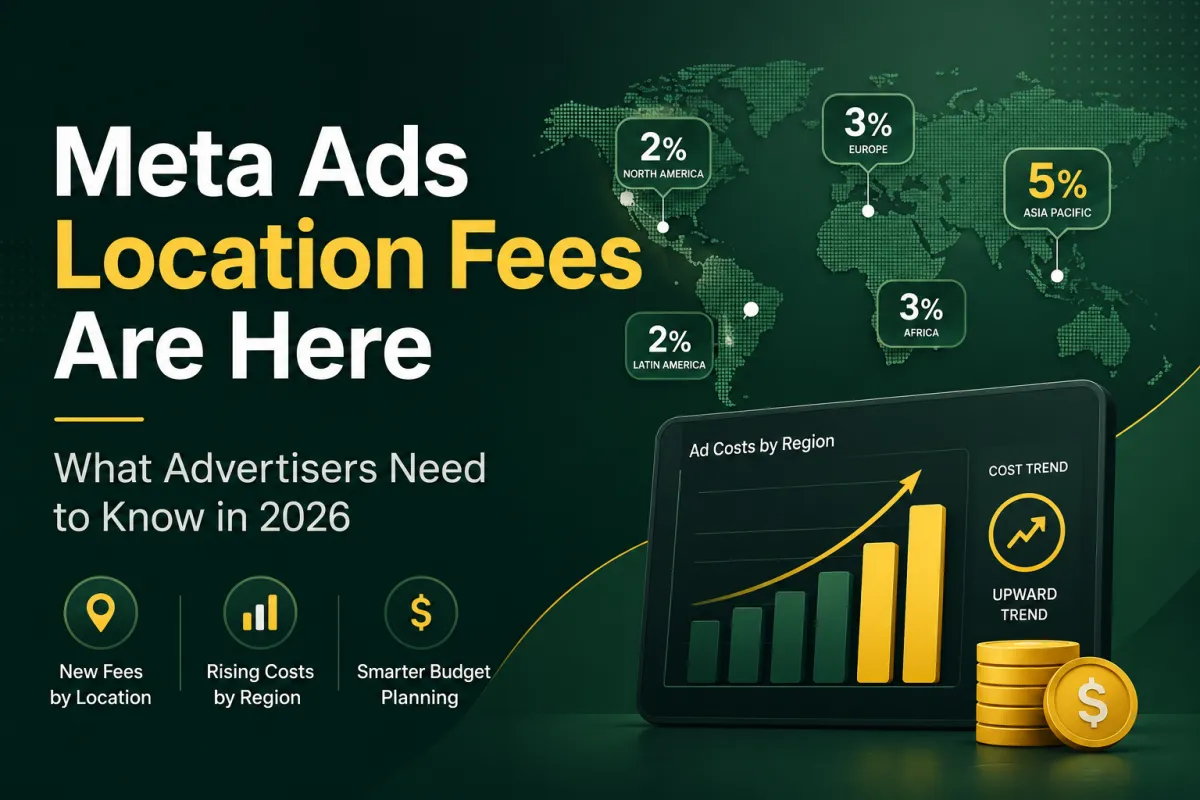
Meta Ads Location Fees Are Here: What Advertisers Need to Know in 2026
Meta Ads location fees are now here
Meta has introduced new location fees for ads delivered in specific countries. This means your Meta Ads bill can now be higher than the campaign budget you set inside Ads Manager.
This is not because your campaign spent over budget. It is because Meta is adding a separate fee after delivery when your ads are shown to people in certain locations.
The key point most advertisers will miss is this:
The fee is based on where your ad is delivered, not where your business is located.
So if your business is in the United States, Hungary, Australia, Canada, or anywhere else, you can still be charged these new Meta location fees if your ads are delivered to people in affected countries.
Meta says these fees are being introduced to cover Digital Services Taxes and other location-based fees imposed on Meta in specific regions. Reuters reported that Meta will charge advertisers a location fee ranging from 2% to 5% from July 1, 2026, following similar moves from Google and Amazon.
This matters because your real CPA, CPL, CAC, and ROAS may now be slightly worse than what you see at campaign level if you are not accounting for the extra fee.
And no, this is not the kind of update you should ignore.
A 2% to 5% fee will not destroy a healthy campaign. But it will expose weak campaigns faster.
If your funnel barely works, this makes it worse. If your margins are already thin, this matters. If you run campaigns across multiple countries, you need to know where your money is actually going.
What are Meta Ads location fees?
Meta Ads location fees are additional charges added to your bill when your ads are delivered to people in specific countries.
These fees are separate from your campaign budget. They are not deducted from your daily or lifetime budget inside Ads Manager. They are added after ad delivery and appear as a separate line item on your invoice or transaction statement.
According to Meta’s own help documentation, if you deliver $100 in ads to Italy, where the location fee is 3%, you would be charged $100 for ad delivery plus a $3 location fee, making the total $103 before any other applicable taxes.
That means if you set a $1,000 campaign budget, your campaign may still spend $1,000 on ad delivery, but your final bill can be higher once location fees and applicable taxes are added.
This is the part that will confuse beginners.
Your campaign budget is not the same thing as your final invoice.
Your campaign budget controls delivery. Your invoice reflects delivery plus applicable fees and taxes.
When did Meta location fees start?
Meta location fees apply from July 1, 2026 for ads delivered in affected countries. Reuters reported the start date as July 1, 2026, and stated that the fee applies to ads delivered on Meta platforms including Facebook, Instagram, WhatsApp click-to-message campaigns, and some marketing messages billed together with ads.
This means advertisers running campaigns into affected regions should already be checking invoices and country-level delivery.
Do not wait until the end of the month and then act surprised when the invoice does not match the campaign spend you expected.
Which countries have Meta location fees?
The initial Meta Ads location fees apply to these countries:
CountryMeta location feeAustria5%France3%Italy3%Spain3%Türkiye5%United Kingdom2%
Reuters reported the same range, with the United Kingdom at 2%, France, Italy, and Spain at 3%, and Austria and Türkiye at 5%. Jon Loomer also listed the same countries and rates in his advertiser update.
The important detail is that these fees are based on ad delivery location.
So if you run one campaign targeting the United Kingdom, France, and Austria, Meta does not simply apply one flat fee to the whole campaign. The fee depends on where impressions are delivered.
UK delivery gets the UK rate. France delivery gets the France rate. Austria delivery gets the Austria rate.
That matters a lot for broad European campaigns.
Example: how much more will Meta Ads cost?
Let’s keep this practical.
If you spend $10,000 on ads delivered to the United Kingdom, the location fee would be 2%.
That means:
Ad delivery: $10,000
Location fee: $200
Total before other applicable taxes: $10,200
If you spend $10,000 on ads delivered to Austria, the location fee would be 5%.
That means:
Ad delivery: $10,000
Location fee: $500
Total before other applicable taxes: $10,500
This is not catastrophic, but it is real money.
And if you are spending $50,000, $100,000, or more per month across these countries, this becomes a serious forecasting issue.
A 5% fee on $100,000 is $5,000.
That $5,000 does not buy you extra impressions, clicks, leads, trials, calls, sales, or customers. It is just an added cost of doing business in that market.
Does the Meta location fee affect campaign performance?
Technically, no.
The fee itself does not change your CPM, CTR, conversion rate, or optimization inside Ads Manager.
But financially, yes.
It affects your real numbers.
This is where advertisers get lazy.
They look at Ads Manager and say:
“My cost per lead is $20.”
But if your actual invoice is 5% higher because of location fees, your real cost is not $20. It is $21 before any other tax considerations.
That may sound small, but small gaps become big gaps at scale.
If you are selling a high-margin offer, you can probably absorb it.
If you are running lead generation with a weak sales process, thin margins, or poor follow-up, this can hurt.
If you are an agency, you also need to explain this clearly to clients before they ask why the invoice is higher than expected.
Will Meta location fees come out of my campaign budget?
No.
This is one of the most important parts of the update.
Location fees are not taken from your campaign budget. They are added separately after ad delivery.
TDMP’s breakdown explains that location fees are itemized by jurisdiction and appear in Billing and Payments in Meta Business Suite and on monthly statements.
So if you set your campaign budget at $100 per day, Meta can still spend that budget on ad delivery. Then the location fee is added on top.
This means your media buying plan needs two numbers:
Ad delivery budget
Total expected invoice cost
Most advertisers only think about the first number. That is a mistake.
Why is Meta adding location fees?
Meta says the fees are related to Digital Services Taxes and other location-based charges. In simple terms, some countries charge large digital platforms extra taxes or regulatory fees, and Meta is now passing some of that cost to advertisers instead of absorbing it.
Reuters reported that Meta said it had previously covered these additional costs, but the change is part of its response to the evolving regulatory landscape and alignment with industry standards.
This is not completely new in the broader ad industry.
Google and Amazon have already passed similar location or regulatory fees to advertisers in certain markets. Meta is now moving in the same direction.
So the real lesson is bigger than this one update:
Digital advertising costs are becoming more fragmented by market.
You cannot just look at CPM anymore.
You need to understand platform fees, tax rules, privacy changes, attribution quality, and country-level profitability.
The lazy media buyer sees one blended CPA.
The serious media buyer knows which countries actually produce profitable customers after all costs.
Which Meta ad types are affected?
According to Reuters, the location fee applies to image or video ads delivered on Meta platforms, including WhatsApp click-to-message campaigns and marketing messages together with ads.
That means advertisers should assume this affects the normal Meta ecosystem, including Facebook and Instagram placements, when ads are delivered in affected countries.
TDMP also notes that Facebook and Instagram ad formats such as image, video, collection, and carousel ads are subject to the fee when delivered in affected jurisdictions.
In plain English:
If you are running Facebook ads or Instagram ads into one of the affected countries, you need to account for the fee.
Who pays the Meta location fee?
The advertiser pays it.
And again, it does not matter where your business is based.
The location fee is based on the location of the user receiving the ad impression. Reuters specifically reported that the fees are determined by where the audience is located, not the advertiser’s business location.
This is the part that will catch international advertisers.
For example:
A US business targeting the UK can pay the UK location fee.
A Hungarian business targeting France can pay the France location fee.
A Canadian business targeting Austria can pay the Austria location fee.
An Australian business targeting Spain can pay the Spain location fee.
Your billing country does not protect you.
Your audience location decides the fee.
What this means for agencies
If you manage client accounts, you need to communicate this update before the client spots it first.
Do not wait for them to ask why the invoice changed.
The worst thing an agency can do is look confused about a billing update the client noticed before them.
Here is the simple client explanation:
“Meta has introduced location-based fees for ads delivered in certain countries. These are separate from campaign spend and are added to the invoice based on where impressions are delivered. This does not mean the campaign overspent. It means Meta is passing on certain country-level digital service costs to advertisers.”
That is the professional answer.
Then you need to update reporting.
Your reports should separate:
Campaign spend
Location fees
Taxes
Total invoice cost
Reported CPA inside Ads Manager
Real CPA after fees
If you do not do this, your reporting is incomplete.
What this means for local businesses
If you only advertise inside one local market, this is easier.
For example, if you are a UK local business targeting only the UK, you can simply assume a 2% location fee on top of your delivery spend.
If you are an Austrian local business targeting Austria, you should assume a 5% location fee.
The mistake would be pretending this does not matter because “it is only a few percent.”
A few percent matters when your sales process is weak.
For local businesses, the answer is not to panic or stop running ads. The answer is to improve the basics:
Better offer
Better landing page
Better lead follow-up
Better tracking
Better creative testing
Better sales process
The location fee is not your biggest problem if your landing page converts at 3% and your sales team takes 24 hours to call leads.
Fix the real leak first.
What this means for e-commerce brands
E-commerce brands need to look at this through the lens of contribution margin.
A 2% to 5% fee can affect profitability if your margins are already tight.
This matters especially if you are running campaigns across several countries and looking only at blended ROAS.
For example, you may see:
UK ROAS: 2.4x
France ROAS: 2.3x
Austria ROAS: 2.2x
At first glance, these markets may look similar.
But after location fees, shipping costs, return rates, VAT, payment fees, and fulfillment differences, one country may be much less profitable than another.
This is why country-level reporting matters.
Do not optimize based only on blended ROAS.
Blended ROAS hides problems.
What this means for Skool group owners, coaches, and creators
If you run ads to grow a Skool community, coaching offer, online course, mastermind, SaaS, newsletter, or creator business, this update matters because many advertisers test international markets to reduce CPMs.
That can still be a smart move.
But now you need to understand your real acquisition cost by country.
For example, targeting outside the US can often reduce CPMs. But cheaper traffic does not automatically mean better customers.
Now add location fees on top.
You need to ask:
Are these leads joining?
Are they showing up?
Are they buying?
Are they staying subscribed?
Are they upgrading?
Are they engaging?
Are they worth the support cost?
This is where most people lie to themselves.
They celebrate cheap leads and ignore bad buyers.
That is not media buying. That is vanity tracking.
If you are running Meta ads for a Skool group, you need to track the full path:
Ad click
Lead
Webinar registration
Show-up
Skool join
Premium upgrade
Retention
LTV
A small Meta location fee does not matter much if your LTV is strong.
It matters a lot if you are already buying low-quality attention.
Should you stop targeting countries with Meta location fees?
No, not automatically.
This is the wrong reaction.
Do not cut a country just because it has a 2% to 5% location fee.
That is lazy.
You should cut a country if it is unprofitable after fees, taxes, sales quality, refund rate, retention, and support cost.
There is a huge difference.
A country with a 5% fee can still outperform a country with no fee if the buyers are better.
A country with no fee can still be garbage if the leads do not convert.
The fee is one input, not the whole decision.
The correct move is to measure country-level profitability.
How to protect your Meta Ads results from location fees
Here is what I would do if you run Meta ads in 2026.
1. Check your affected country delivery
Look at where your ads are actually being delivered.
If you are running broad campaigns across Europe, do not assume delivery is evenly distributed. Meta will push spend where it finds cheaper or more scalable opportunities.
That may or may not match your business goals.
Check country breakdowns and compare:
Spend
CPM
CTR
CPC
Lead cost
Purchase cost
Conversion rate
Revenue
Retention
Refunds
Actual invoice impact
Do not make decisions from one metric.
2. Build location fees into your target CPA
If your target CPA is $50 and you are advertising in a 5% fee country, your real target needs to account for that.
A $50 CPA inside Ads Manager can become $52.50 before other applicable taxes.
That may be fine.
But if your breakeven CPA is already $51, you have a problem.
You either need better conversion rates, better AOV, better LTV, or lower media cost.
3. Separate reporting by country
If you are targeting multiple countries, do not rely only on campaign-level averages.
Campaign averages are useful for a quick overview, but they hide the truth.
You need to know which countries are producing profitable customers.
For lead generation, that means tracking lead quality by country.
For e-commerce, that means tracking purchase value, refund rate, delivery cost, and repeat purchase behavior by country.
For Skool, SaaS, coaching, and community offers, that means tracking trial quality, paid conversion, retention, and upgrades by country.
4. Watch your invoices, not just Ads Manager
Ads Manager will show ad delivery performance.
Your invoice shows what you actually paid.
Those are not the same thing anymore if location fees apply.
This is especially important for agencies and media buyers reporting to clients.
If your client asks why the final charge is higher than Ads Manager spend, you need to explain it clearly.
5. Do not use this as an excuse for poor performance
This update will cause some advertisers to blame Meta for campaigns that were already weak.
Do not do that.
A 2% to 5% location fee is annoying. It is not the reason your offer does not convert.
If your creative is weak, fix the creative.
If your landing page is weak, fix the landing page.
If your follow-up is slow, fix the follow-up.
If your tracking is messy, fix the tracking.
If your offer is unclear, fix the offer.
The fee makes the math slightly harder. It does not replace the fundamentals.
How to calculate your blended Meta location fee
If you advertise across multiple affected countries, you can estimate your blended fee.
Let’s say your campaign spends:
60% in the UK at 2%
30% in France at 3%
10% in Austria at 5%
The blended location fee would be:
60% x 2% = 1.2%
30% x 3% = 0.9%
10% x 5% = 0.5%
Total blended fee: 2.6%
So if your total campaign spend is $10,000, your estimated location fee would be $260 before other applicable taxes.
This is the kind of calculation advertisers should add to their media plans.
Not because it is complicated.
Because ignoring it makes your numbers fake.
Simple Meta Ads location fee calculator
Use this quick formula:
Ad spend x location fee percentage = estimated location fee
Examples:
$1,000 x 2% = $20
$1,000 x 3% = $30
$1,000 x 5% = $50
$10,000 x 2% = $200
$10,000 x 3% = $300
$10,000 x 5% = $500
$100,000 x 2% = $2,000
$100,000 x 3% = $3,000
$100,000 x 5% = $5,000
Again, this does not include other applicable taxes or billing considerations. Talk to your accountant if you need tax-specific guidance.
The real lesson from the Meta location fees update
The real lesson is not that Meta ads are suddenly bad.
The real lesson is that media buying is getting less forgiving.
Costs are going up. Tracking is less perfect. Regulations are changing. AI is making creative production faster. Competition is still high. Platforms are passing more costs to advertisers.
So the advertisers who win are not the ones chasing hacks.
They are the ones who know their numbers.
They know:
What a lead is worth
What a customer is worth
Which countries are profitable
Which creatives create buyers, not just clicks
Which offers convert
Which follow-up systems turn attention into revenue
Which campaigns are actually scalable
This is why a real Meta Ads system matters.
Not random boosting.
Not guessing audiences.
Not copying someone else’s campaign structure.
Not blaming every update.
A real system.
FAQ: Meta Ads location fees
What are Meta Ads location fees?
Meta Ads location fees are extra charges added to your bill when your ads are delivered to people in specific countries. They are separate from your campaign budget and are based on the audience’s location.
Which countries have Meta location fees?
The initial affected countries are Austria, France, Italy, Spain, Türkiye, and the United Kingdom. Rates range from 2% to 5%.
How much is the UK Meta location fee?
The United Kingdom location fee is 2%.
How much is the Austria Meta location fee?
Austria has a 5% Meta location fee.
How much is the France Meta location fee?
France has a 3% Meta location fee.
How much is the Italy Meta location fee?
Italy has a 3% Meta location fee. Meta’s own example explains that $100 in ad delivery to Italy would result in a $3 location fee, making the total $103 before other applicable taxes.
How much is the Spain Meta location fee?
Spain has a 3% Meta location fee.
How much is the Türkiye Meta location fee?
Türkiye has a 5% Meta location fee.
Is the Meta location fee based on my business location?
No. The fee is based on where your audience is located and where your ads are delivered, not where your business is based.
Are Meta location fees included in my campaign budget?
No. Location fees are separate from your campaign budget and are added to your bill after ad delivery. TDMP notes that they appear in Billing and Payments and on monthly statements.
Should I stop advertising in countries with location fees?
Not automatically. You should only reduce or stop spend if the country is unprofitable after factoring in fees, taxes, conversion rate, customer quality, retention, and lifetime value.
Final thoughts
Meta Ads location fees are not the end of Facebook and Instagram advertising.
But they are another reminder that you need to manage ads like a business owner, not like someone gambling with boosted posts.
If your campaigns are profitable, this update is manageable.
If your campaigns are already weak, this update makes the weakness more obvious.
The advertisers who win from here will be the ones who understand their numbers, test better creative, track country-level profitability, and build systems instead of guessing.
If you want more practical Meta Ads updates, campaign breakdowns, testing systems, creative workflows, and support, join my Skool community here:
https://www.skool.com/advertising
Inside Meta Ads Systems, I share updates like this, explain what they actually mean, and show you how to build campaigns with a real system instead of reacting to every platform change.