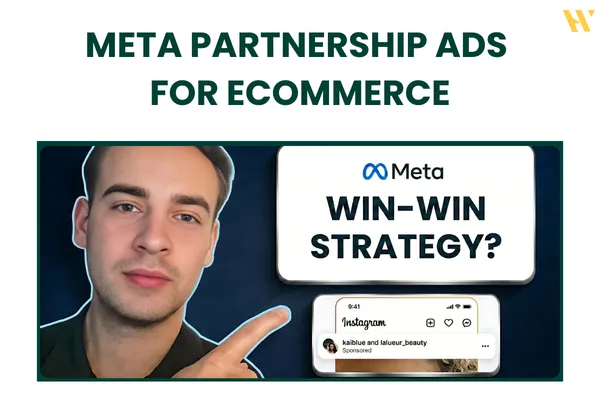
Meta Partnership Ads for Ecommerce: The Win-Win Influencer Strategy That Actually Converts
Meta Partnership Ads are one of the most misunderstood and underused ad formats for ecommerce brands. Most brands either overpay influencers for shoutouts that never convert or run UGC ads that lack trust and social proof. Partnership Ads solve both problems if you know how to use them correctly.
In this guide, you’ll learn exactly what Meta Partnership Ads are, how they work, when to use them, and how to set them up step by step inside Meta Ads Manager. This is not theory. This is a practical system ecommerce brands can apply immediately.
What Are Meta Partnership Ads
Meta Partnership Ads allow advertisers to promote content that lives on an influencer’s Instagram account while still running the ad from their own business ad account.
Instead of downloading an influencer’s video and posting it on your brand page, you advertise directly from the influencer’s post. The influencer keeps the engagement on their profile, and the brand gets the performance benefits of paid ads.
This creates a true alignment of incentives. Influencers want engagement and growth. Brands want sales. Partnership Ads give both sides what they want.
Why Partnership Ads Work Better Than Traditional Influencer Ads
Traditional influencer marketing usually fails for three reasons.
First, brands pay upfront with no performance guarantee. Second, the content often feels like an obvious ad. Third, once the post is live, the brand has no control over scaling it.
Partnership Ads fix this.
The ad appears as a collaboration between the brand and the creator. This increases trust instantly. The content already looks native because it is native. And once the brand has the partnership code, they can scale the ad just like any other Meta campaign.
This is why Partnership Ads often outperform standard UGC ads in CTR and conversion rate.
When You Should Use Meta Partnership Ads
Partnership Ads are ideal if you are an ecommerce brand selling physical products and already working with creators or influencers.
They work especially well for:
Product seeding campaigns
Influencer whitelisting strategies
UGC driven performance ads
Brands scaling on Facebook and Instagram
If you have creators who can produce short form video content that feels authentic, this format should be part of your ad stack.
How Influencers Create a Partnership Ad Code
The process starts on the influencer’s side.
They need to enable branded content in their Instagram settings. Once branded content is enabled, they can choose one of their posts and generate a partnership ad code.
This code is what allows the advertiser to run ads from that specific post. Without the code, you cannot create a Partnership Ad.
Once the influencer generates the code, they simply send it to the brand or agency.
Setting Up Partnership Ads in Meta Ads Manager
Once you receive the partnership code, the setup inside Meta Ads Manager is extremely fast.
You create a new ad as usual, then enable the Partnership Ads toggle. You paste the partnership code into the field at the top of the ad setup.
Meta will automatically pull in the influencer’s post. You can then choose your business identity as the secondary identity, add your website URL, select a call to action, and publish.
The entire process takes about one minute once the code is ready.
Choosing the Right Identity Setup
One of the most important parts of Partnership Ads is the identity structure.
The primary identity is the influencer. This is what the user sees in their feed. The secondary identity is your brand. This gives you credibility while keeping the content native.
This setup is what makes Partnership Ads feel less like ads and more like recommendations.
Common Mistakes Brands Make With Partnership Ads
The biggest mistake is using low quality influencer content. Partnership Ads amplify whatever you put behind them. If the video is weak, no ad setup will save it.
Another mistake is not aligning incentives. Influencers should care about the performance of the content, not just delivering a post.
Finally, many brands treat Partnership Ads as a replacement for creative testing. They are not. They are a scaling and trust tool, not a shortcut.
How to Scale Partnership Ads Correctly
Once you find a Partnership Ad that converts, you can scale it like any other Meta ad.
You can increase budget, duplicate into scaling campaigns, or test it across different audiences. The key advantage is that all engagement stays on the influencer’s post, which compounds social proof over time.
This makes Partnership Ads ideal for evergreen campaigns.
Final Thoughts
Meta Partnership Ads are not a trend. They are a structural advantage for ecommerce brands that understand how trust and native content drive performance.
If you are already using influencers but not Partnership Ads, you are leaving performance on the table.
To see the exact setup process inside Meta Ads Manager, watch the full video tutorial below.
👉 Watch the full Meta Partnership Ads tutorial on YouTube.


